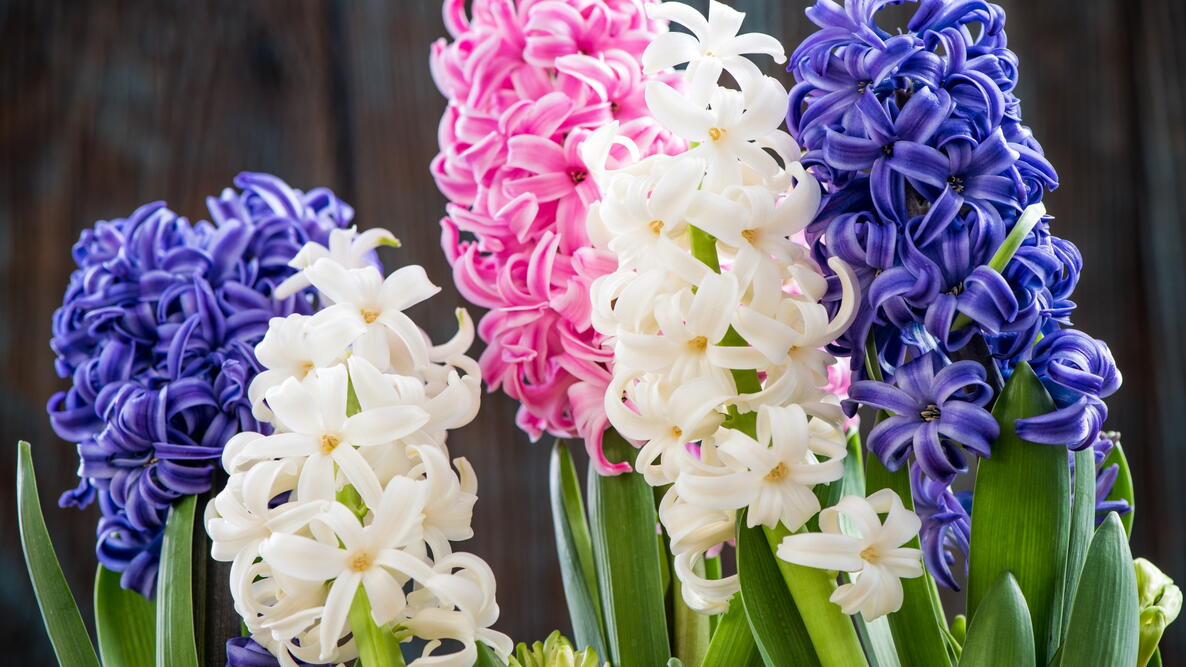
Ahhh, the scent of hyacinths in full bloom—springtime’s little perfume bottles! And don’t even get us started on the tiny cobalt-blue Muscari, sneaking in like miniature bells of joy.
Whether you’re planting them in pots, borders, or bouquets, these fragrant spring bulbs are sure to make your garden (and your nose) very happy.
About Hyacinths and Grape Hyacinths
- Hyacinths (Hyacinthus): Originally a pale blue or violet flower, hyacinths now come in a rainbow of colors, including lilacs, pinks, white, cobalt blue, cream, apricot, and even a blood-red hue. Each hyacinth bulb generally produces one flower stalk that stands 8 to 10 inches tall. The hyacinth’s loose-to-dense racemes (clusters) of strongly fragrant flowers may be closely packed single or double flowers.

- Grape hyacinths (Muscari) are not directly related to true hyacinths, but also bloom in mid-spring and have the same care requirements. This tiny wonder has small clusters of bell-shaped, cobalt-blue flowers.

Note: This page will refer to both Hyacinthus and Muscari plants as “hyacinths” for simplicity’s sake!
As hyacinths are one of the first blooms, they look best at the front of a perennial garden, near the front door, along a walkway, or in mixed borders. These beauties are also a great choice for pots and planters. Hyacinths make wonderful cutting flowers, too, and look stunning in bouquets. As the flowers are famous for their fragrance, you can bring the sweet scent of spring inside!
Please note: Most hyacinths grow in Zones 3 to 9. They must have cold temperatures of 40° to 45°F (4° to 7°C) for at least 12 to 14 weeks. If temperatures in your area do not get this cold, you’ll need to pre-chill the bulbs in a refrigerator before planting them outdoors.
Warning: Hyacinth bulbs (and daffodil bulbs) contain a substance called oxalic acid, which can be irritating to bare skin. Use gloves when handling these bulbs for extended periods.
Planting
Where to Plant Hyacinths
Choose a planting site that gets full sun for the largest blooms and straightest stems. The bulbs are tolerant of partial shade as well.
Grow in loosened, moderately fertile soil that drains well. Avoid planting low areas where water collects; hyacinths will rot in wet soil! Before planting, loosen the soil and work in 2 to 4 inches of compost or bonemeal for fertility.
When to Plant Hyacinths
Like other spring-blooming bulbs, plant hyacinth bulbs in mid-to-late autumn, any time after your first fall frost and before the ground freezes.
How to Plant Hyacinths
- Plant hyacinth bulbs 4 to 5 inches deep. Space bulbs 5 to 6 inches apart (grape hyacinths can be 2 inches apart). At the northern limits of their hardiness (USDA Zone 3), plant 1 to 2 inches deeper to ensure winter hardiness.
- Dig out a larger area if you wish to plant five or more bulbs simultaneously. Hyacinths look beautiful in groupings of five to nine bulbs. Grape hyacinths also look best in masses and loose drifts.
- Set the bulb in the hole with the pointy end up.
- After planting and covering with soil, water thoroughly.
- Apply a 1- to 2-inch layer of mulch around the plants to discourage weeds and disease.
- If you are transplanting, water sparingly and then do not water again until flower buds appear the following year.

Forcing Hyacinth Bulbs Indoors
- Hyacinth bulbs may be forced into early growth for indoor display in the winter. Plant them with the tips just showing, in soil-based potting mix in containers with drainage holes.
- Keep in a dark place at temperatures above freezing but no higher than 45°F (7°C), for at least 10 weeks to allow roots to develop.
- When shoots are about 1 inch long, increase light and temperature gradually.
- Water carefully and avoid wetting the shoots or waterlogging the soil. Soil should be moist, not wet.
- After flowering, forced hyacinths may be transplanted into the garden, and they will flower again in subsequent years.
Types
- Hyacinth orientalis ‘Blue Jacket’: One of the great blues of the flower world. These award-winning hyacinths display big columns of royal blue florets with crisp white edges.
- H. orientalis ‘City of Haarlem’: A wonderful heirloom variety that’s been popular since the late 1800s. The flowers are soft, primrose yellow, maturing to creamy white.
- H. orientalis ‘Gypsy Queen’: ‘Gypsy Queen’ is an heirloom hyacinth with salmon pink petals with peach and buttery-yellow highlights.
- H. orientalis ‘Jan Bos’: Intensely fragrant, this award-winning hyacinth has fuschia-pink florets that are tightly packed into large flowerheads.
- H. orientalis ‘Miss Saigon’: With a deep, rich purple color, this fragrant hyacinth is covered with starry, violet florets. Gorgeous!
- H. orientalis ‘Pink Pearl’: Rose-pink flower heads turn heads with their cotton-candy sweetness; ‘Pink Pearl’ is a favorite for spring containers to add a pop of color.
- Muscari armeniacum: This grape hyacinth has small and delicate cobalt-blue flowers that look gorgeous when planted en masse.

More Like This

Could you have planted them too deep? Hyacinths should be planted only 3-4 inches into the soil. If they're too deep, they may struggle to emerge properly.
Leave it in the pot, Richard. Give it balanced (not strong light) keep the water to the lower middle of the bulb until after it blooms (add no more water then), and let the foliage fade away. There is no guarantee that it will bloom again, but you can cut off the dead foliage and plant the bulb about 6 inches deep and see what, if anything, happens next spring. If you do not live in an area that experiences winter, nothing will happen; hyacinths need a cold spell to bloom. So it’s best to enjoy it now…and buy a new plant when it passes.
If you have several inches of mulch, then the bulbs themselves should be fine. To protect the leaves and buds that have emerged, then you may want to provide frost protection the afternoon before a frost is predicted overnight. You can use row covers, sheets, etc., ideally propped up on stakes (or hoops) so as not to touch (and possibly damage) the plants--be sure that all edges of the fabric are tucked into the soil, to prevent cold air from seeping in under the fabric. Another alternative is to cover each bulb individually with something like a plastic jug or inverted flower pot. Remove the fabric or other protection in the morning just after temperatures rise above freezing. Watering the soil before covering the plants can also help.
- « Previous
- 1
- 2
- …
- 10
- Next »

Comments