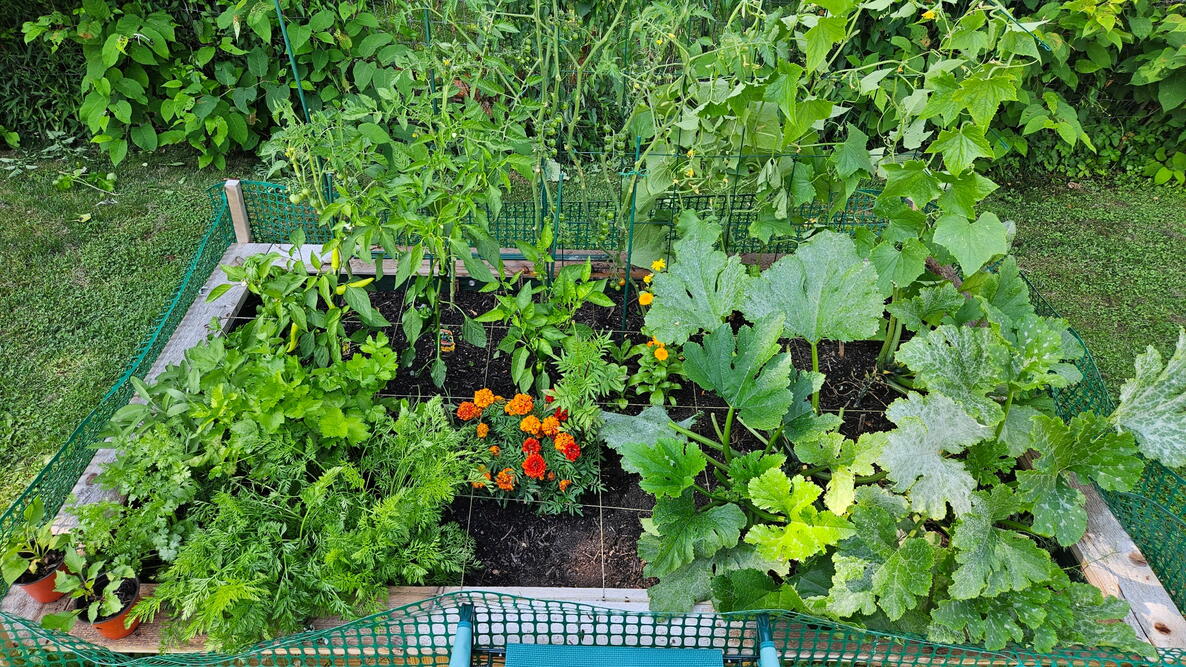
Want a square-foot garden plan you can actually follow? This 7 × 4-foot raised-bed layout divides the garden into 28 one-foot squares, with vegetables, herbs, and flowers planted at the proper number of plants per square.
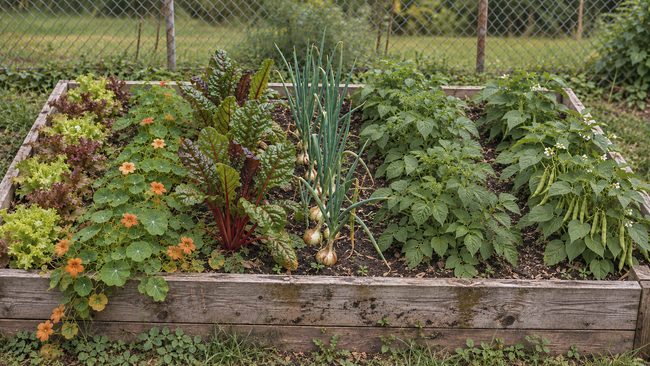
The plan is based on Renee’s real backyard garden, shown in the photo above. Use her layout as a starting point, follow the plants-per-square guide, or swap in crops you prefer while keeping the same square-foot spacing.
Quick Plan Overview
| Feature | Details |
|---|---|
| Garden Type | Square-foot raised-bed garden |
| Difficulty Level | Beginner |
| Sun Exposure | Full sun; at least 6 hours of direct sun daily |
| Seasonality | Spring through fall |
| Soil Type | Rich, well-drained raised-bed soil |
| Watering Needs | Regular, consistent moisture |
| Special Features | 28 one-foot squares with plants spaced according to crop size |
| Garden Size | 7 × 4 feet (28 square feet) |
Square-Foot Garden Layout
Square-foot gardening divides a raised bed into 1 × 1-foot sections. Instead of planting in long rows, you grow a set number of plants in each square based on how much space that crop needs.
Renee’s 7 × 4-foot garden has 28 one-foot squares. The number shown in each square tells you how many plants to grow there—for example, one tomato plant or 16 carrots in a square. See our Square-Foot Gardening guide for more about the method.
Garden Layout
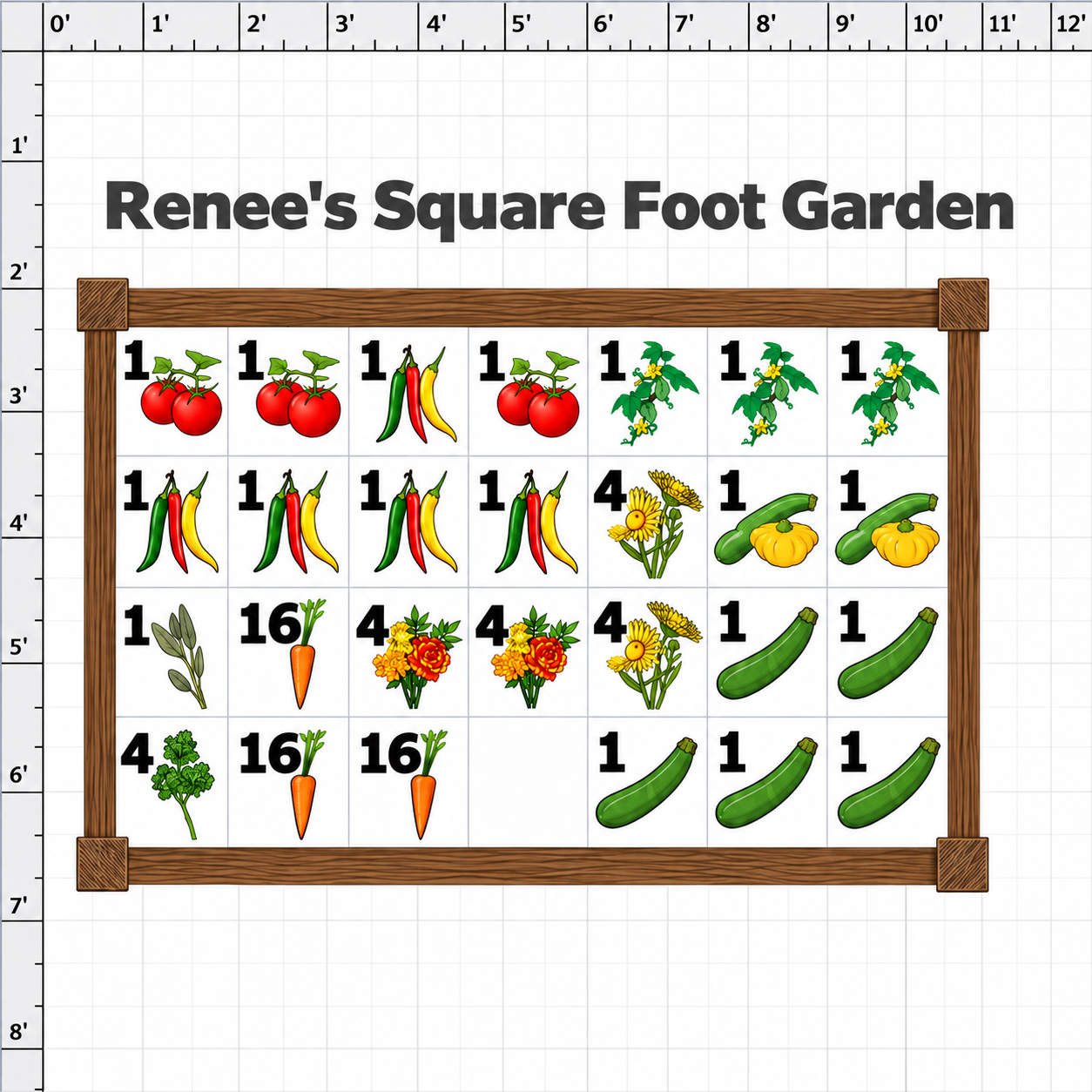
To calculate how many plants you need, multiply the number of plants per square by the number of squares used for that crop. For example, Renee’s plan has three carrot squares at 16 carrots per square, for a total of 48 carrots.
Plant List
This plant list matches Renee’s square-foot garden plan above. “Plants per Square” shows how many plants are grown in each 1-foot-square section.
| Plant | Plants per Square |
|---|---|
| Calendula | 4 |
| Carrot | 16 |
| Chili pepper | 1 |
| Cucamelon | 1 |
| Marigold | 4 |
| Parsley | 4 |
| Sage | 1 |
| Summer squash | 1 |
| Small tomato | 1 |
| Zucchini | 1 |
One square is left open at the front of the bed. Renee suggested filling it with 1 nasturtium, 1 oregano plant, or 16 radishes. Choose whichever best fits what you want to grow.
Need growing instructions? See our Vegetable Growing Guides for crop-by-crop advice.
How to Plant This Square-Foot Garden
- Check your planting dates. Planting dates vary by location. Use the Almanac Planting Calendar to find local dates based on last frost before you start planting.
- Prepare the raised bed. Fill the bed with a loose, fertile, well-drained raised-bed mix with plenty of compost or other organic matter. Use our Soil Calculator to estimate how much soil you need.
- Mark the 1-foot squares. Divide the growing area into a 7 × 4 grid, creating 28 squares that each measure 1 × 1 foot. You can mark the grid with thin wood strips, string, or another simple divider.
- Plant with the season. Cool-tolerant crops such as carrots, radishes, and parsley can be planted earlier. Wait until after the danger of frost has passed and the weather has warmed before planting tomatoes, peppers, zucchini, summer squash, and cucamelons.
- Follow the plants-per-square spacing. Smaller crops can grow more densely than large crops. In Renee’s plan, for example, one square holds 16 carrots, while a tomato or zucchini gets an entire square.
- Water consistently. Keep the soil evenly moist, especially during hot weather. A soaker hose or drip irrigation can make a densely planted raised bed easier to water at soil level.
- Replant empty squares. When an early crop is harvested, add a little compost if needed and use the open square for another crop suited to the season. Fast-growing vegetables such as radishes are especially useful for succession planting.
The Almanac Garden Planner includes a Square-Foot Gardening feature that places crops in squares and calculates the number of plants needed.
Gardener Spotlight: Renee’s Experience
“Hello! I am so grateful to the Almanac Garden Planner! This was my first year creating a vegetable garden, and I decided to start small with a single raised bed. I mapped out each square of my bed.
“I grew almost everything from seed—gratifying once those first sprouts appeared. Carrots popped up in little clusters and my chili peppers stood like tiny sentinels!”
“I added marigolds and calendula as companion plants to keep pests away. They nicely filled their squares with such cheerful color. I even tried “cucamelons—tiny, crunchy, and surprisingly easy to grow. Next season may bring a second raised bed!”
More Garden Plans to Explore
- 4×8 Vegetable Garden Layout for Beginners — Another compact raised-bed plan for beginning gardeners.
- Raised-Bed Vegetable Garden Plan — A larger raised-bed layout for growing a wider mix of vegetables.
- Vegetable Container Garden Plan — A flexible option for patios, decks, and other small spaces.
Frequently Asked Questions
-
How big is each square in a square-foot garden?
Each section measures 1 × 1 foot. Renee’s 7 × 4-foot raised bed contains 28 individual planting squares.
-
Does a square-foot garden need a special raised bed?
No. You can use an existing raised bed and add a simple grid. A bed about 4 feet wide is convenient because you can reach the center from either side without stepping on the soil.
-
Do I need a special soil mix for square-foot gardening?
The garden will perform best with loose, fertile, well-drained soil rich in organic matter. Adding compost helps provide nutrients and improve soil structure.
-
Can I change the plants in Renee’s layout?
Yes. Substitute crops you prefer, but keep the plants-per-square spacing appropriate for each crop. Large plants may need a full square, while smaller vegetables such as carrots and radishes can grow much more densely.
-
Can I plant a square again after I harvest it?
Yes. That’s one advantage of organizing the garden into individual squares. Once a crop is finished, you can replant that space with another vegetable suited to the remaining growing season.


Vegetable Garden Plans
Flower Garden Plans

Comments