Planting
When to Plant Strawberries
Plan to plant when the ground can be worked in the spring. See your local frost dates.
Where to Plant Strawberries
Strawberry plants require 6 to 10 hours of direct sunlight a day, so choose a sunny spot. Otherwise, strawberries are tolerant of different soil types, although they prefer loamy soil that drains well.
Preparing the Soil for Strawberries
To ensure a strong start, add a few buckets of well-rotted manure before planting; you could also use garden compost. If you have clay soil, generally mix in 4 inches or more of compost and rake the clay soil into raised mounds to further improve drainage. If your soil is sandy, simply cultivate lightly to remove weeds and mix in a 1-inch layer of rich compost or rotted manure.
Soil pH should be between 5.5 and 7. If necessary, amend your soil before planting. If soils in your area are naturally alkaline, it is best to grow strawberries in half-barrels or other large containers filled with compost-enriched potting soil. Raised beds are a particularly good option for strawberry plants.
Practice crop rotation for the most success. Unless you plan to amend your soil each year, do not plant in a site that recently had tomatoes, peppers, or eggplant.
Also, note that strawberries and garlic are good planting companions if you wish to interplant. Garlic helps deter pests like spider mites.
- Establish new plants each year to maintain high berry quality each season. Strawberry plants will produce runners (daughter plants) that root and grow into new strawberry plants.
- Buy disease-resistant plants from a reputable nursery, of a variety that is recommended in your area. You can consult with the nursery you buy them from or with your state Cooperative Extension service for locally recommended varieties.
- You can buy strawberries in pots, but also you can sometimes find bare-root strawberries or runners, which offer really excellent value for money. They look fairly shocking, without any leaves and rather scraggly, but don’t let that put you off. Once they hit the soil, they’ll be well away!
How to Plant Strawberries
- Provide adequate space for sprawling. Allow for spacing of around 18 inches (1-1/2 feet) to leave room for runners and leave 4 feet between rows. Strawberries are sprawling plants. Seedlings will send out runners, which, in turn, will send out their own runners. (Container strawberries can be planted closer together.)
- Plant holes should be deep and wide enough to accommodate the entire root system without bending it. However, don’t plant too deep! The roots should be covered, but the crown should be right at the soil surface. It is very important that you do NOT bury the crown (central growing bud) of the plant, or it could rot. The leaves, flowers, and fruit must be exposed to light and fresh air.
- To settle their roots into the soil, water plants well at the time of planting.
- Use a mulch of the strawberry’s namesake—straw!
- It is also possible to grow strawberries from last year’s runners. See this video to find out how.
Planting Strawberries in Containers
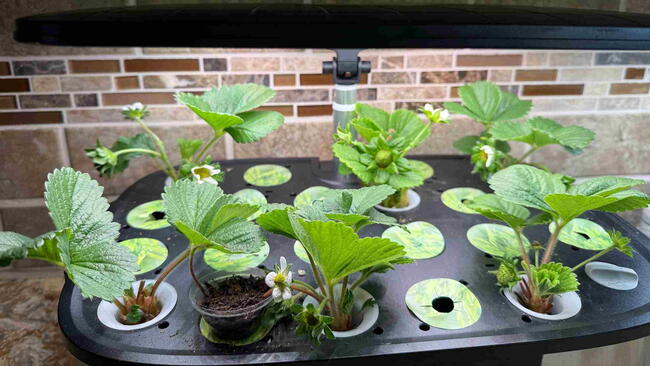
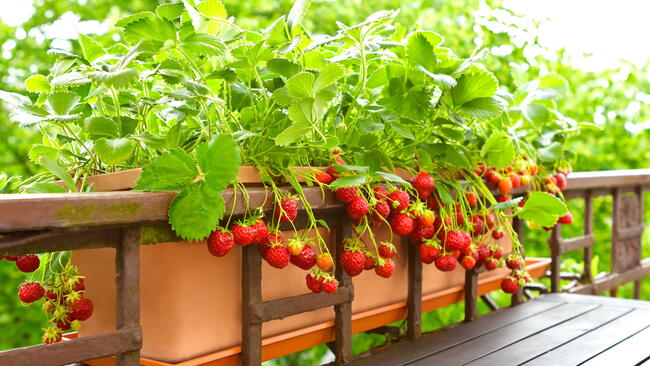
Potted strawberries are easy to get right. They go in at the same depth as the potting mix in the container, but for bare-rooted plants, make sure you don’t go too deep or too shallow. If too deep, the plant may struggle and could potentially rot away. If it is too shallow, it will rock about and dry out really easily, creating a weak and brittle plant. You want the crown of the plant where the stems of the leaves emerge to be ever so slightly above the soil surface. Learn more about growing strawberries in pots.
Watch this video to see how to plant strawberries in garden beds or containers.
Growing
How to Grow Strawberries
- The big tip with strawberries is to keep them well watered while they are establishing their roots and during dry weather. Moisture is incredibly important due to its shallow roots. Water adequately, about one inch per square foot per week. Strawberry plants need a lot of water when the runners and flowers are developing and again in the late summer when the plants are fully mature and gearing up for winter dormancy.
- Keep strawberry beds mulched to reduce water needs and weed invasion. Any type of mulch—from black plastic to pine straw to shredded leaves—will keep the soil moist and the plants clean. Read more about mulching.
- Be diligent about weeding—weed by hand, especially in the first months after planting.
- Once strawberries flower, fertilize them with a high-potassium, liquid tomato feed to encourage good fruit production. Plants also benefit from the addition of an organic, general-purpose fertilizer early in spring, as they set into growth, to help power things up for the new season.
- In the first year, pick off blossoms to discourage strawberry plants from fruiting. If not allowed to bear fruit, they will spend their food reserves on developing healthy roots instead, which is a good thing. The yields will be much greater in the second year.
- Eliminate runner plants as needed. First and second generations produce higher yields. Try to keep daughter plants spaced about 10 inches apart.
- Row covers are a good option for protecting blossoms and fruit from birds.
Winter Care of Strawberries
Strawberry plants are perennial. They are naturally cold-hardy and will survive mildly freezing temperatures. So, if your area has mild winters, little care is needed.
In regions where the temperature regularly drops into the low twenties (Fahrenheit), strawberries will be in their dormant stage. It’s best to provide some winter protection:
- When the growing season is over, mow or cut foliage down to one inch. This can be done after the first couple of frosts or when air temps reach 20°F (-6°C).
- Mulch plants about 4 inches deep with straw, pine needles, or other organic material.
- In even colder regions, more insulating mulch should be added.
- Natural precipitation should appropriately maintain sufficient soil moisture.
- Remove mulch in early spring after the danger of frost has passed.
How to Propagate Strawberries
Strawberries produce long, wiry stems called runners with little plantlets along them. You can use these to grow more strawberries by just pinning the plantlets down to the root and then severing them from the mother plant once they have. See our article for details on how to grow more strawberries!
Harvesting
How to Harvest Strawberries
- When you grow your own, you can pick at the peak of ripeness. No more white strawberries! Harvest only fully red (ripe) berries, and pick every 3 days.
- Fruit is typically ready for harvesting 4 to 6 weeks after blossoming.
- Ideally, pick fruits in the warmth of the afternoon for maximum flavor.
- Cut by the stem; do not pull the berry, or you could damage the plant.
- For June-bearing strawberries, the harvest will last up to 3 weeks. Depending on the variety, you should have an abundance of berries.
How to Store Strawberries
- Store unwashed berries in the refrigerator for 3 to 5 days.
- Strawberries can be frozen whole for about 2 months.
- Dehydrate them or turn them into delicious jams. Learn how to Make Strawberry Preserves!
Types
Strawberry Plants Come in Four Types
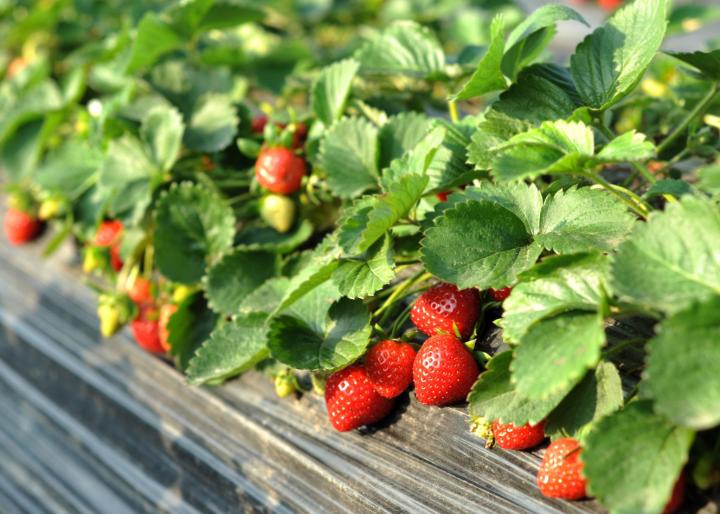
- June-bearing strawberries bear fruit in one go, usually over a period of three weeks. The berries tend to be larger. Despite their name, you can choose from early-, mid-, and late-season varieties that fruit anytime from early to late summer.
- Everbearing strawberries (also called perpetual or all-season strawberries) produce steadily throughout the summer and even into autumn. They have smaller berries and are great for making jam or freezing.
- Day-neutral strawberries (closely related to everbearers) also produce fruit continuously throughout the season. Insensitive to day length, these varieties produce buds, fruits, and runners continuously if the temperature remains between 35° and 85°F (1° to 30°C). Production is less than that of June-bearers.
- Alpine Strawberries: In a little world of their own are the alpine and wild strawberries. These are much smaller plants that form far smaller berries, but they have an almost impossibly intense flavor—perfect for topping your morning cereal, for example! They require less attention than bigger strawberry plants and, once established, will pretty much look after themselves, making an attractive edging plant or even growing out from the cracks or walls.
They will naturally self-seed to create a useful edible ground cover.
For the home garden, we recommend June-bearers. Although you will have to wait a year for fruit harvesting, it will be well worth it.
Summer-Fruiting / June-Bearing | Everbearing / Perpetual | Day-Neutral |
Short, intense cropping period | Small flushes over longer periods | Steady production all season long |
Larger berries | Medium-sized berries | Medium-sized berries |
Fruits in the summer | Fruits from summer to autumn | Fruits from summer to autumn |
Vigorous runner production | Fewer runners | Moderate runner production |
Learn more about choosing and growing different strawberry varieties.



- « Previous
- 1
- 2
- …
- 10
- Next »

Comments