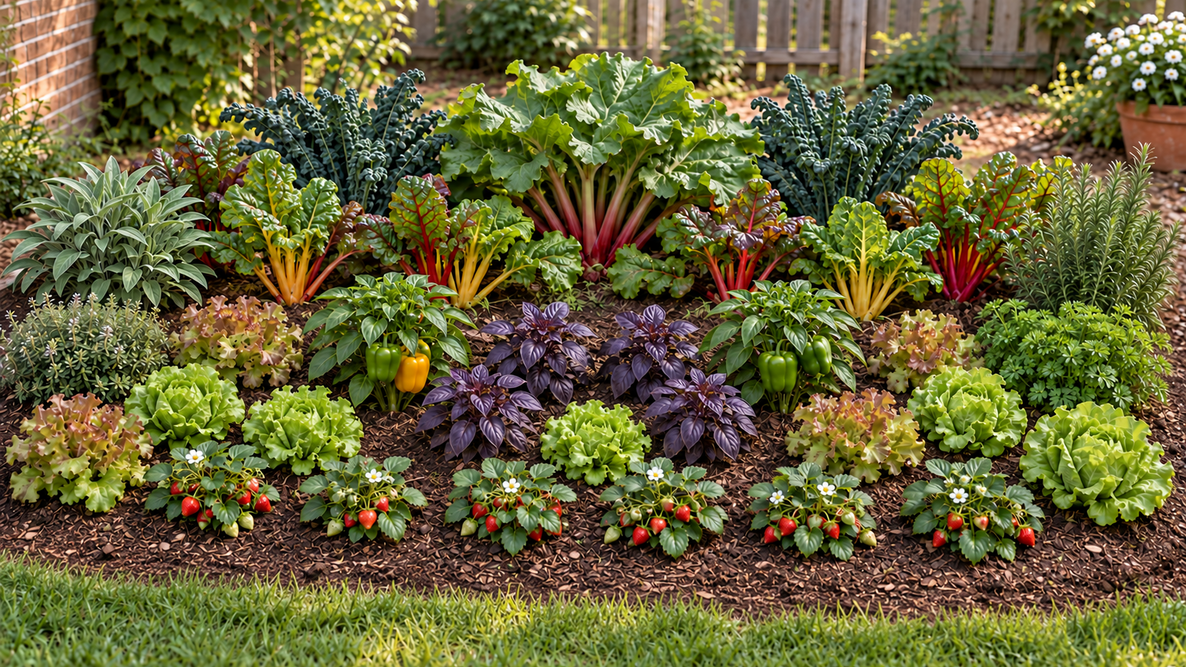
Starting a vegetable garden doesn’t require a big yard. This 5 × 10 backyard vegetable garden layout gives you a manageable in-ground bed filled with vegetables, herbs, rhubarb, and strawberries.
The plan shows exactly what to plant, how many plants you need, and where to place them. Follow it as shown for an easy starting point, or use it as inspiration for your own 50-square-foot garden.
Quick Plan Overview
| Feature | Details |
|---|---|
| Garden Type | In-ground vegetable garden |
| Garden Size | 5 × 10 feet |
| Difficulty | Beginner |
| Sun Exposure | Full sun; at least 6 hours of direct sun daily |
| Season | Spring through fall |
| Soil | Rich, well-drained garden soil |
| Watering | Regular, consistent moisture |
| Best For | Beginners, small backyards, and gardeners who want a mix of vegetables, herbs, and fruit |
5×10 Backyard Vegetable Garden Layout
This compact in-ground garden combines taller plants toward the back with lower crops toward the front, making the bed easier to see, tend, and harvest.
The layout includes vegetables, herbs, strawberries, and rhubarb in one 50-square-foot space. Use the plant positions and quantities as your starting point, then adjust individual varieties to suit your climate and what you like to eat.

Plant List
This plant list matches the 5 × 10-foot garden layout above.
| Plant | Quantity | Type |
|---|---|---|
| Rhubarb | 1 | Perennial |
| Kale | 2 | Annual |
| Swiss chard | 6 | Annual |
| Peppers | 2 | Annual |
| Purple basil | 4 | Annual |
| Alpine strawberries | 6 | Perennial |
| Leaf lettuce | 6 | Annual |
| Crisphead lettuce | 6 | Annual |
| Sage | 1 | Perennial |
| English thyme | 1 | Perennial |
| Rosemary | 1 | Annual or Perennial |
| Parsley | 1 | Annual |
Need growing instructions? See our Vegetable Growing Guides.
Backyard Garden Plant Information
- Rhubarb (perennial): Large, deep-green leaves grow from thick, edible pink-to-red stalks. A mature plant can reach about 3 feet tall and wide. One plant.
- Kale (annual): Upright plants produce nutritious leaves in many colors and textures. Try blue-green ‘Lacinato’ or frilly purple ‘Redbor’ for extra color. Two plants.
- Swiss chard (annual): Large edible leaves grow on colorful stalks. ‘Bright Lights’ produces stems in yellow, pink, red, orange, and other shades. Six plants.
- Peppers (annual): Bushy plants produce small flowers followed by colorful fruit. Choose sweet or hot peppers according to your taste. Two plants.
- Purple basil (annual): Deep-purple foliage adds both flavor and color to the garden. ‘Dark Opal’, ‘Osmin’, and ‘Purple Ruffles’ are good choices. Four plants.
- Alpine strawberries (perennial): Compact, non-spreading plants produce small white flowers followed by intensely flavored berries. Six plants.
- Leaf and crisphead lettuce (annual): This plan uses both loose-leaf and heading lettuces for a mix of colors, textures, and harvests. Six leaf lettuce plants and six crisphead lettuce plants.
- Sage (perennial): Aromatic gray-green foliage forms a bushy clump and can produce spikes of bluish flowers. One plant.
- English thyme (perennial): A compact culinary herb with tiny fragrant leaves and small white-to-pink flowers. One plant.
- Rosemary (annual or perennial): Needlelike, aromatic foliage grows on upright stems. In colder regions, grow rosemary as an annual or overwinter it indoors. One plant.
- Parsley (annual): Flat-leaf or curly parsley forms a compact mound of flavorful green foliage. One plant.
How to Grow This Backyard Vegetable Garden
- Choose a sunny spot. Give the garden at least 6 hours of direct sun each day. Peppers, basil, rosemary, and strawberries will generally produce best with plenty of light.
- Prepare the soil. Loosen the soil before planting and mix in compost or other organic matter to improve fertility and drainage.
- Plant with the season. Lettuce, kale, and chard prefer cooler weather, while peppers and basil need warmer conditions. Planting dates will vary by location.
- Water consistently. Keep the soil evenly moist, especially while plants are becoming established and during hot, dry weather.
- Harvest regularly. Pick leafy greens, herbs, peppers, and strawberries as they become ready to encourage continued growth and production.
Because this plan mixes cool-season and warm-season crops, the garden will change through the growing season. In many areas, lettuce and kale will be at their best earlier, while peppers and basil become more productive as the weather warms.
More Garden Plans to Explore
Frequently Asked Questions
-
Can all of these plants grow at the same time?
There can be some overlap, especially in late spring and early summer, but not every plant will be at its peak at the same time. Cool-season crops such as lettuce and kale prefer milder temperatures, while peppers and basil thrive once the weather warms.
-
Can I make this garden larger or smaller?
Yes. Keep the recommended spacing between plants rather than simply squeezing more plants into a smaller bed. For a smaller garden, reduce the number of plants while keeping the same general arrangement.
-
Do I need a raised bed for this plan?
No. This plan is designed as a 5 × 10-foot in-ground garden. You can adapt the same planting arrangement to a raised bed of similar dimensions if you prefer.
-
Can I substitute other vegetables or herbs?
Yes. Choose replacements with similar spacing, mature size, and sun requirements. You can also use the Almanac Garden Planner to customize the layout for the crops you want to grow.


Vegetable Garden Plans
Flower Garden Plans
More Like This

Hi John,
Grasshoppers are very hard to control. Eggs overwinter in the soil and grasshopper nymphs emerge in the spring. The best time to try to control them is during the nymph stage. Some natural predators that eat the nymphs are chickens, guinea hens, larks and bluebirds. NOLO Bait or Semaspore (a microbial pathogen) infect and kill some grasshopper species, if applied early in the season.

Comments