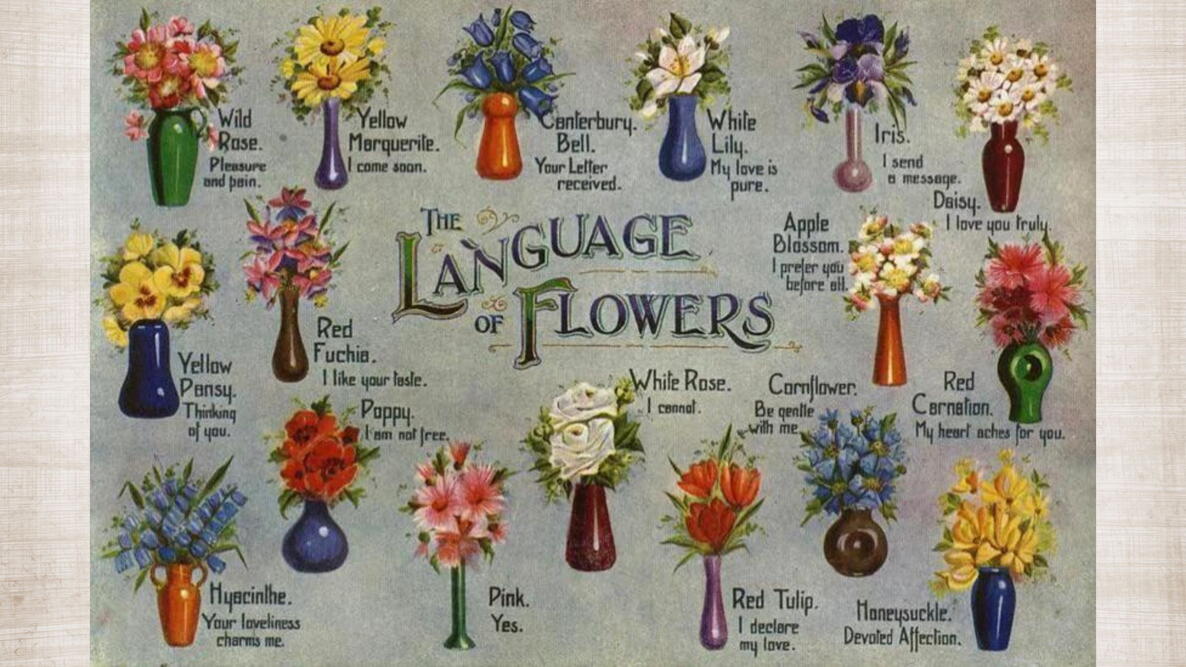
Caption
Illustrated postcard. Printed in England/The Regent Publishing Co Ltd.
Discover the language of flowers with the Almanac’s complete chart of Flower Meanings. When selecting flowers—for a Mother’s Day bouquet, your garden, or even a tattoo—know the symbolic meaning of your favorite flowers.
Flower Meanings Chart
See our chart below for meanings of herbs, flowers, and other plants. (Please note: Our chart below reflects mainly Victorian flower language.)
Click on linked plant names for a photo and growing guide.
| Plant | Meaning |
|---|---|
| Abatina | Fickleness |
| Acanthus | The fine art, Artifice |
| Aloe | Affection, also Grief |
| Amaryllis | Pride |
| Anemone | Forsaken |
| Angelica | Inspiration |
| Apple blossom | Preference |
| Arborvitae | Unchanging friendship |
| Aster | Symbol of love, Daintiness |
| Baby’s breath | Everlasting Love |
| Bachelor’s button | Single blessedness |
| Basil | Good wishes |
| Bay tree | Glory |
| Begonia | Beware |
| Belladonna | Silence |
| Bittersweet | Truth |
| Black-eyed Susan | Justice |
| Bluebell | Humility |
| Borage | Bluntness, Directness |
| Butterfly weed | Let me go |
| Calla lily | Beauty |
| Camellia, pink | Longing for you |
| Camellia, red | You’re a flame in my heart |
| Camellia, white | You’re adorable |
| Candytuft | Indifference |
| Carnation | Fascination, Female love, Mother’s love |
| – Red carnation | Alas for my poor heart, My heart aches, Deep love |
| – White carnation | Innocence, pure love, sweet love |
| – Pink carnation | I’ll never forget you |
| – Striped | Refusal |
| – Yellow carnation | Disdain, Disappointment, Rejection |
| Chamomile | Patience in adversity |
| Chives | Usefulness |
| Chrysanthemum, red | I love you |
| Chrysanthemum, yellow | Slighted love |
| Chrysanthemum, white | Truth |
| Clematis | Mental beauty |
| Clematis, evergreen | Poverty |
| Clover, white | Think of me |
| Columbine | Foolishness, Folly |
| - Columbine, purple | Resolution |
| - Columbine, red | Anxious, Trembling |
| Coreopsis | Always cheerful |
| Coriander | Hidden worth/merit |
| Crab blossom | Ill nature |
| Crocus, spring | Cheerfulness, Youthful gladness |
| Cyclamen | Resignation, Diffidence, Goodbye |
| Daffodil | Regard, Unequalled love |
| Dahlia, single | Good taste |
| Daisy | Innocence, Loyal love, I’ll never tell |
| Daylily | Chinese emblem for mother |
| Dill | Powerful against evil |
| Edelweiss | Courage, Devotion |
| Fennel | Flattery |
| Fern | Magic, Fascination, Secret bonds of love |
| Forget-me-not | True love memories, Do not forget me |
| Gardenia | You’re lovely, Secret love |
| Geranium | Folly, Stupidity |
| Gladiolus | Flower of the Gladiators, Integrity, Strength, Victory |
| Goldenrod | Encouragement, Good fortune |
| Heliotrope | Eternal love, Devotion |
| Hibiscus | Delicate beauty |
| Holly | Defense, Domestic happiness |
| Hollyhock | Ambition |
| Honeysuckle | Bonds of love |
| Hyacinth | Sport, Game, Play |
| – Blue Hyacinth | Constancy |
| – Purple Hyacinth | Sorrow |
| – Yellow Hyacinth | Jealousy |
| – White Hyacinth | Loveliness, Prayers for someone |
| Hydrangea | Gratitude for being understood, Frigidity and heartlessness |
| Hyssop | Sacrifice, Cleanliness |
| Iris | Faith, trust, Wisdom, Hope, Valor |
| Ivy | Affection, Friendship, Fidelity |
| Jasmine, white | Sweet love, Amiability |
| Jasmine, yellow | Grace; Elegance |
| Lady Slipper | Capricious beauty |
| Larkspur | Open heart, Levity, Lightness, Fickleness (pink or simple varieties). |
| Lavender | Distrust |
| Lemon balm | Sympathy |
| Lilac | Joy of youth |
| Lily (white) | Virginity, Purity, Heavenly |
| Lily (yellow) | Happy, Gay, Walking on air |
| Lily (orange) | Hatred |
| Lily, tiger | Wealth, Pride |
| Lily-of-the-valley | Sweetness, Tears of the Virgin Mary, Humility |
| Lotus Flower | Purity, Enlightenment, Self-regeneration, and Rebirth |
| Magnolia | Nobility, Love of nature |
| Marigold | Grief, Jealousy |
| Marjoram | Joy, Happiness |
| Mint | Virtue |
| Morning glory | Affection |
| Myrtle | Good luck, Love in a marriage |
| Nasturtium | Patriotism, Conquest, Victory in Battle |
| Oak | Strength |
| Oregano | Substance |
| Pansy | Thoughts |
| Parsley | Festivity |
| Peony | Bashful, Happy life, Shame |
| Pine | Humility, Piety |
| Poppy | Consolation |
| Rhododendron | Danger, beware |
| Rose, red | Love, I love you |
| Rose, dark crimson | Mourning |
| Rose, pink | Happiness |
| Rose, white | Innocence, Heavenly, I’m worthy of you |
| Rose, yellow | Jealousy, Decrease of love, Infidelity |
| Rosemary | Remembrance |
| Rue | Grace, Clear vision |
| Sage | Wisdom, Immortality |
| Salvia, blue | I think of you |
| Salvia, red | Forever mine |
| Savory | Spice, Interest |
| Snapdragon | Deception, Graciousness |
| Sorrel | Affection |
| Southernwood | Constancy, Jest |
| Spearmint | Warmth of sentiment |
| Speedwell | Feminine fidelity |
| Sunflower, dwarf | Adoration |
| Sunflower, tall | Haughtiness |
| Sweet pea | Blissful pleasures, Goodbye, Thank you for a lovely time |
| Sweet William | Gallantry |
| Sweet woodruff | Humility |
| Tansy | Hostile thoughts, Declaring war |
| Tarragon | Lasting interest |
| Thyme | Courage, strength |
| Tulip, red | Passion, Declaration of love |
| Tulip, yellow | Sunshine in your smile |
| Valerian | Readiness |
| Violet | Watchfulness, Modesty, Faithfulness |
| Willow | Sadness |
| Yarrow | Everlasting love |
| Zinnia | Thoughts of absent friends, Lasting affection |
Flower Meanings by Color
Flowers provide an incredibly nuanced form of communication. Some plants, including roses, poppies, and lilies, could express a wide range of emotions based on their color alone.
Take, for instance, all of the different meanings attributed to variously colored carnations: Pink meant “I’ll never forget you”; red said “my heart aches for you”; purple conveyed capriciousness; white was for “the sweet and lovely”; and yellow expressed romantic rejection.
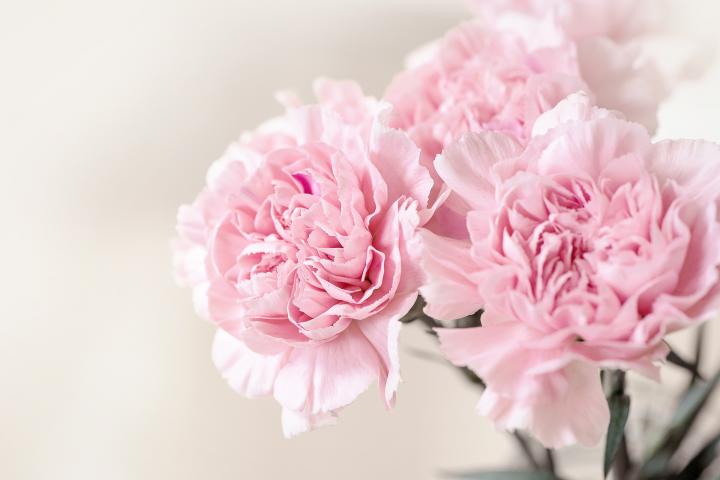
Likewise, a white violet meant “innocence,” while a purple violet said the bouquet giver’s “thoughts were occupied with love.” A red rose was used to openly express feelings of love, while a red tulip was a confession of love. The calla lily was interpreted to mean “magnificent beauty,” and a clover conveyed “think of me.”
Unsurprisingly, the color of the rose plays a huge role. Red roses symbolize love and desire, but roses come in a variety of colors, and each has its own meaning.
- White rose: purity, innocence, reverence, a new beginning, a fresh start.
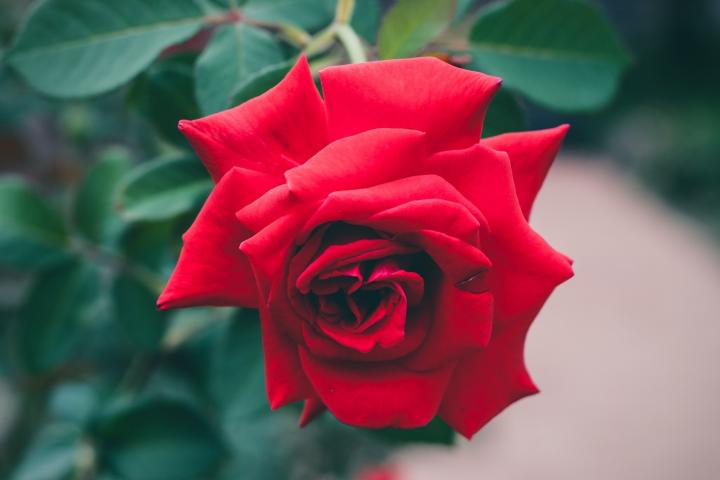
- Red rose: love; I love you.
- Deep, dark crimson rose: mourning.
- Pink rose: grace, happiness, gentleness.
- Yellow rose: jealousy, infidelity.
- Orange rose: desire and enthusiasm.
- Lavender rose: love at first sight.
- Coral rose: friendship, modesty, sympathy.
Flowers by Meaning
Flowers That Symbolize Love
- Red rose: Love and desire
- Red tulip: Declaration of love
- Honeysuckle: Bonds of love
- Heliotrope: Eternal love and devotion
- Forget-me-not: True-love memories
Flowers That Symbolize Friendship
- Arborvitae: Unchanging friendship
- Ivy: Friendship and fidelity
- Yellow rose: Friendship in modern flower symbolism
- Zinnia: Thoughts of absent friends
Flowers That Symbolize Remembrance
- Rosemary: Remembrance
- Forget-me-not: Do not forget me
- Poppy: Consolation
- Zinnia: Thoughts of absent friends
Flowers That Symbolize Strength or Courage
- Oak: Strength
- Thyme: Courage and strength
- Gladiolus: Strength, integrity, and victory
- Edelweiss: Courage and devotion
Flowers That Symbolize New Beginnings
- White rose: A new beginning or fresh start
- Lotus: Rebirth and self-regeneration
- Daffodil: Regard and unequaled love
The History of Flower Meanings
The language of flowers has been recognized for centuries in many countries throughout Europe and Asia. They even play a large role in William Shakespeare’s works. Mythologies, folklore, sonnets, and plays of the ancient Greeks, Romans, Egyptians, and Chinese are peppered with flower and plant symbolism—and for good reason.
Whether you’re giving flowers to a mother for Mother’s Day, a friend on their birthday, or a beloved on Valentine’s Day, nearly every sentiment imaginable can be expressed with flowers. The orange blossom, for instance, means chastity, purity, and loveliness, while the red chrysanthemum means “I love you.”
Flower Language of the Victorian Era
Learning the special symbolism of flowers became a popular pastime during the 1800s. Nearly all Victorian homes had, alongside the Bible, guidebooks for deciphering the “language,” although definitions shifted depending on the source.
Following the protocol of Victorian-era etiquette, flowers were primarily used to deliver messages that couldn’t be spoken aloud. In a sort of silent dialogue, flowers could be used to answer “yes” or “no” questions. A “yes” answer came in the form of flowers handed over with the right hand; if the left hand was used, the answer was “no.”
Plants could also express aversive feelings, such as the “conceit” of pomegranate or the “bitterness” of aloe. Similarly, if given a rose declaring “devotion” or an apple blossom showing “preference,” one might return to the suitor a yellow carnation to express “disdain.”
How flowers were presented and in what condition was important. If the flowers were given upside down, then the conveyed idea was the opposite of what was traditionally meant. How the ribbon was tied said something: Tied to the left, the flowers’ symbolism applied to the giver, whereas tied to the right, the sentiment was in reference to the recipient. And, of course, a wilted bouquet delivered an obvious message!
More examples of plants and their associated human qualities during the Victorian era include bluebells and kindness, peonies and bashfulness, rosemary and remembrance, and tulips and passion. The meanings and traditions associated with flowers have certainly changed over time, and different cultures assign varying ideas to the same species. Still, the fascination with “perfumed words” persists just the same.
What Wedding Flowers Mean
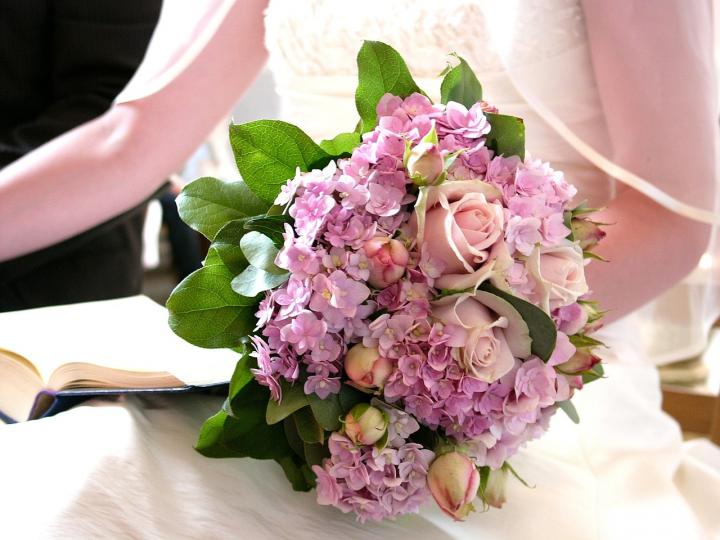
One tradition is to select the flowers of a wedding bouquet based on plant symbolism. For example, look to the royal flower bouquet at the wedding of Prince William, Duke of Cambridge, to Kate Middleton (now Catherine, Duchess of Cambridge). Her all-white bouquet had lily-of-the-valley (representing trustworthiness, purity), sweet William (gallantry), hyacinth (loveliness), myrtle (love in marriage), and ivy (continuity). Altogether, these flowers’ meanings reveal the hope of a loving, everlasting marriage.
The groom, too, wore a flower that appeared in the bridal bouquet in his buttonhole. This stems from the medieval tradition of a man wearing his lady’s colors to declare his love.
One fun modern idea is to give each bridesmaid a bouquet featuring a signature flower whose meaning suits her personality.
There is a language, little known,
Lovers claim it as their own.
Its symbols smile upon the land,
Wrought by nature’s wondrous hand;
And in their silent beauty speak,
Of life and joy, to those who seek
For Love Divine and sunny hours
In the language of the flowers.
–The Language of Flowers, London, 1875
Now discover the meaning of birth month flowers!
Frequently Asked Questions
-
What is the language of flowers?
The language of flowers, also called floriography, is the practice of using flowers to communicate feelings and messages. It became especially popular during the Victorian era, when flowers could express sentiments that people might not speak aloud.
-
What flowers symbolize new beginnings?
White roses commonly represent a new beginning or fresh start. Lotus flowers symbolize rebirth and self-regeneration, while daffodils are often associated with renewal and the arrival of spring.
-
Do flower meanings change according to color?
Yes. The same type of flower can convey different messages depending on its color. A red rose signifies romantic love, for example, while a white rose represents purity and a yellow rose traditionally symbolized jealousy.
-
Are flower meanings the same in every culture?
No. Flower meanings vary among cultures, historical periods, and sources. The meanings in our chart are drawn primarily from the Victorian language of flowers, so they may differ from modern or non-Western interpretations.
Sources
- Iowa State University — Flowers and Their Meanings: The Language of Flowers
- Smithsonian Gardens — The Language of Flowers

More Like This

- « Previous
- 1
- 2
- …
- 10
- Next »

Comments